
Nothing here is financial advice. Go look for an entry point instead. No Chasing and No FOMOing!!
Disclosure: I have used excessive AI generated memeS for this article.
• • •
Everyone thinks the battery business is about batteries.
Cells. Chemistry. Gigawatt-hours. Who makes the cheapest box.
They’re looking at the wrong thing.

The actual money is NOT in making the battery. It’s in running it.
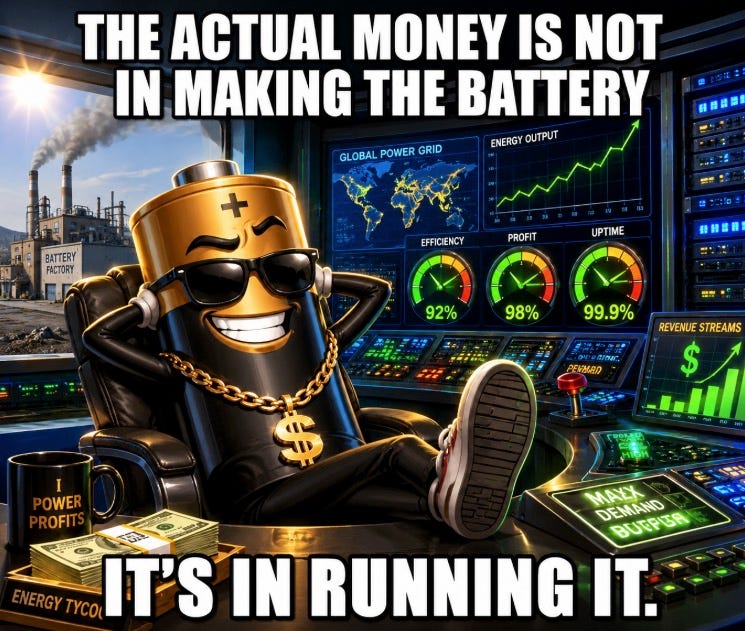
Charging when power is cheap, discharging when it’s expensive, and getting paid a third time just for being on standby. Same physical asset, many revenue streams
A well-run battery is a quant trading desk wearing a steel enclosure.
This is the model that quietly produced the best numbers in the entire energy sector last year. Not the panel makers. Not the cell makers. The owner-operators!!
INSIGHT 1: THE BOX IS THE COMMODITY. THE TRADING IS THE BUSINESS.
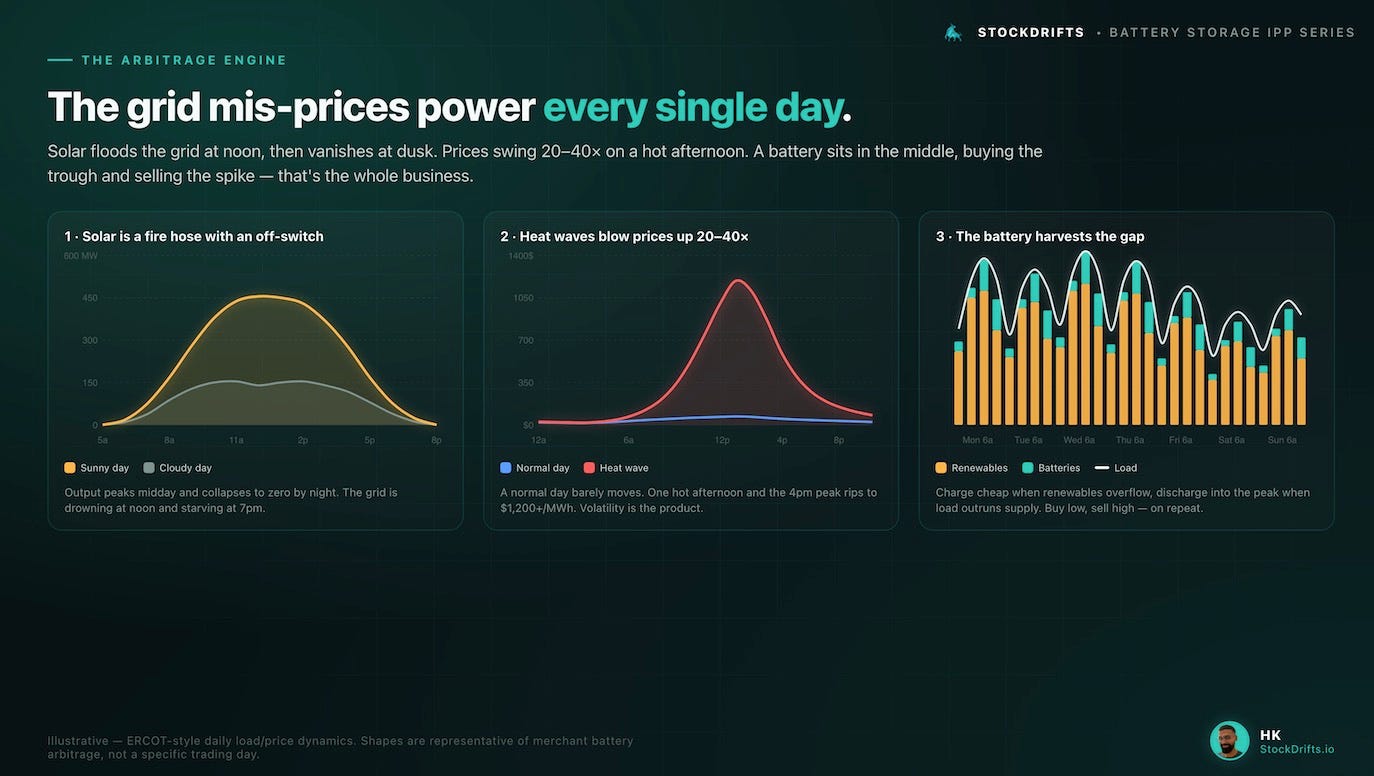
Battery costs are massively down and there is currently an oversupply in batteries due to China subsidizing this industry for a few years now.
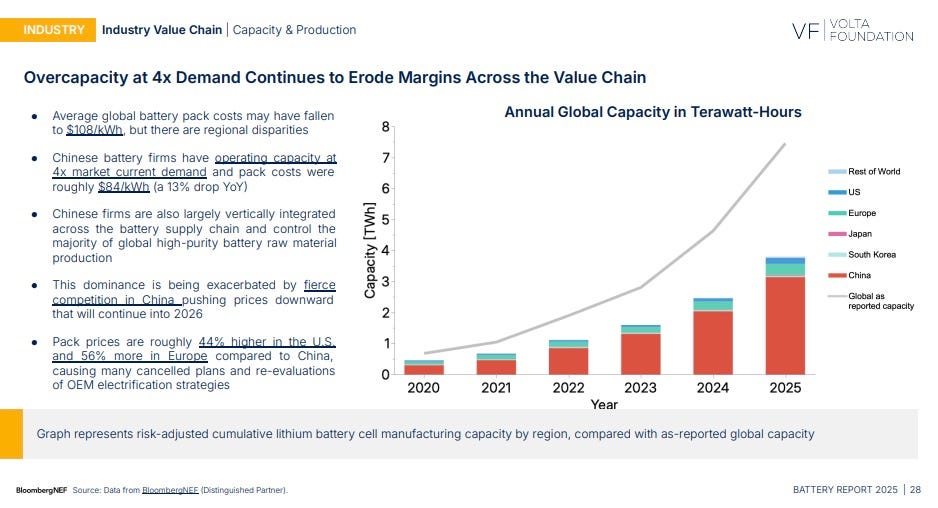
Lets unpack what a merchant battery actually does in a day.
Midday, solar floods the grid. Power prices crater — sometimes negative. (Hello Germany!!) The battery buys. (Yes, sometimes it gets paid to charge.)
Evening, the sun sets, everyone turns on the AC and the EV charger, prices spikes multiple x’es. The battery sells.
That spread — buy at $10, sell at $40-$80 — is the entire game. The battery is long volatility. It doesn’t care if power is cheap or expensive. It cares that the price moves.
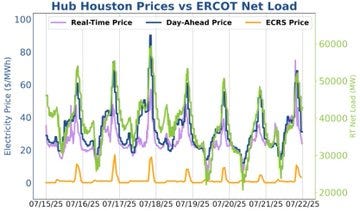
I have written about this insight extensively last year here.

And it stacks with other use cases. A battery earns from:
Energy arbitrage — buy low, sell high, every single day.
Ancillary services — frequency regulation and reserves, where you get paid just to be available to respond in milliseconds. Pure standby income.
Capacity payments — utilities pay you to exist so they don’t have to build a peaker plant.
The grid pays for all of it because it physically cannot keep the lights on without something that absorbs solar’s midday glut and releases it at 7pm.
Punchline: you’re not selling electricity. You’re selling optionality
Here is a great illustration
