In January/Feb I called $TOYO the naughtier girlfriend of the solar trade. The stock almost did 150-200% since I shared it
If you wish you can read the original thesis here. They are releasing their Q2 Earnings tomorrow.
But then it gave it all back — 75% off the $17.43 high, trading currently at $5.65
And now my DMs all ask the same thing: is the thesis dead?
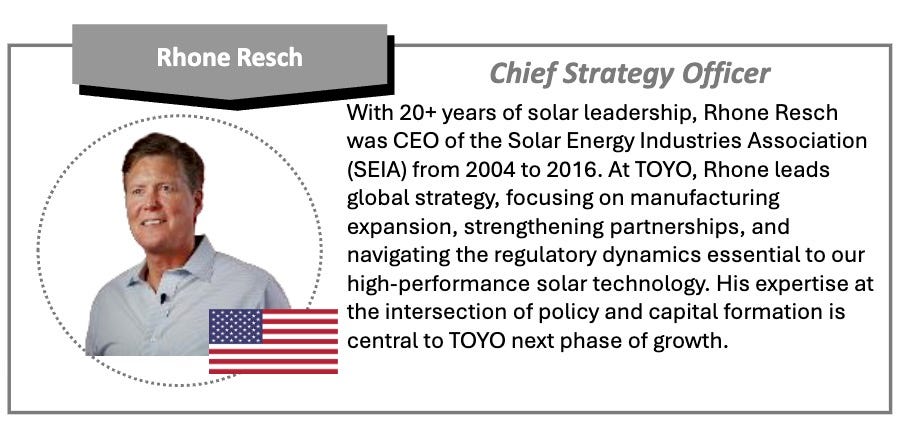
I sat down with the management Rhone Resch (CSO) on a recorded 42-minute call to walk through all of it. Here’s the full honest picture — the good, the hedged, and the dangerous risks
It is the only Solar business that reports Positive EBITDA and Positive Net income (±100M of EBITDA in 2025 and guided for $90-100M of Net income in 2026) without 45X credits
There are a lot of Policy related unknowns that will need answering
Here is a refresher. The company has been experiencing a massive growth
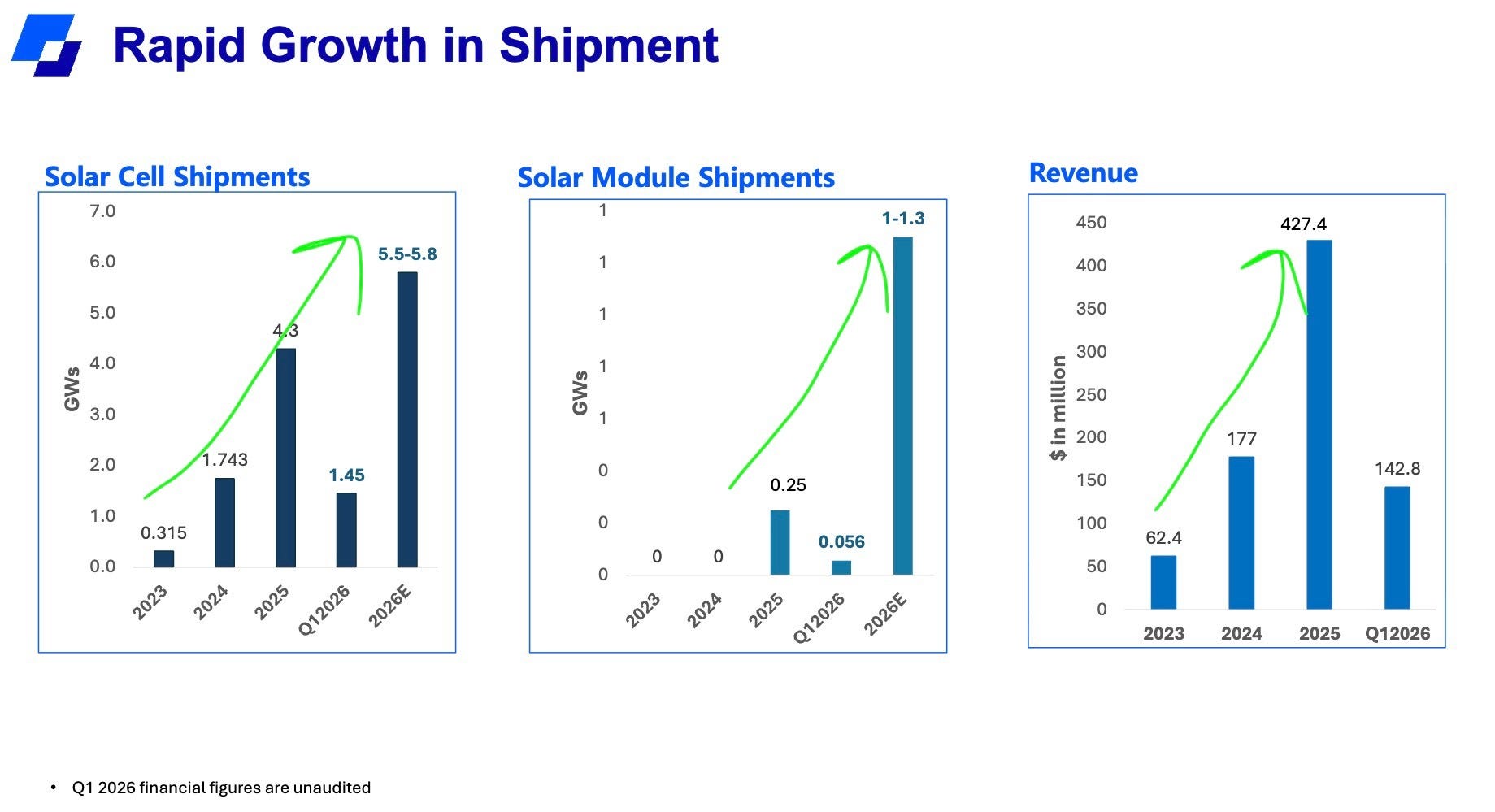
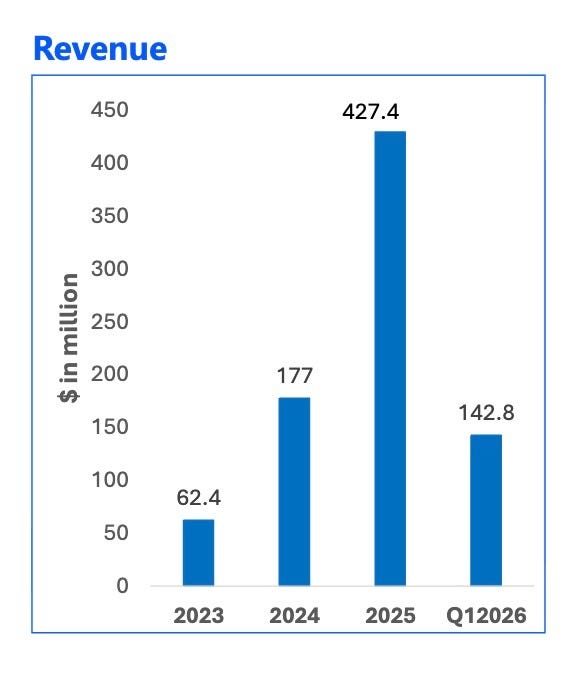
Q1 2026: $142.8M revenue, up a massive 177% YoY. Gross profit $47.8M — a 33.5% margin!! Net income $28.4M.
One quarter. A year earlier, the same quarter was a $3.7M loss.
Have a look again.
Market cap: $240M. That’s ±2.4x current P/E, for a company that’s growing massively. Value-stock pricing on a growth-stock income statement.
Q1 operating cash flow was +$33.4M. Customers have prepaid $133M in deposits for future modules.
So why 2.4x Only? Clearly there are big risks. I will explore further, but here they are in short
AD/CVD circumvention on Ethiopia. That Ethiopia’s duty-free status doesn’t survive
§337 Patent issue that FSLR sued all of the industry naming TOYO as an infringer. TE/T1 just recently spent 135M acquiring Singapore-based Evervolt Green Energy Holding for Topcon Patents.
Texas funding gap. ±$310M funding gap exists for the HJT facility that they are trying to resurrect in the US
Section 232, how much benefits can they claim?
What management told me on the call
Four things stood out. I’m quoting precisely, because precision is the whole point here.
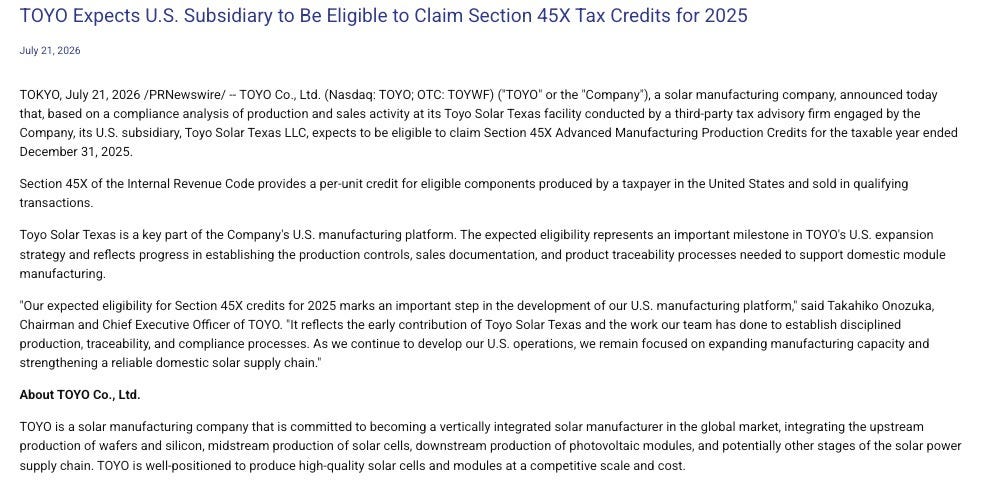
On the 45X tax credits - up-to-$0.07/watt subsidy for US-made modules. They are generating credits at the Houston plant. They have booked nothing and sold nothing. A third-party legal opinion is in hand for 2025, another in progress for 2026. When I pushed — do the credits come for sure? — the answer was:
“We’re not going to say for sure... we only recognize them on the P&L once we actually either sold them or have a verification from the IRS.”
That’s the conservative answer, and I respect it. But note what it is not: booked money. Buyers now want the credits wrapped in insurance before they pay. An actual executed credit sale would almost certainly be a stock mover event. Completely not priced in for 2026. Although the slides have 45X through 2030 pasted everywhere.
On dilution. The $357M Texas cell fab needs funding, and the June raise — $50M at $11, with a full warrant at $13.20 attached — cost the stock 38.8% in a single day. Management’s words on the call:
“Anything equity or equity-linked is not a viable source of financing at this point. The plan is 45X monetization, non-dilutive debt, and operating cash”
Read that carefully. It means “we can’t issue at these prices.” It does not mean “we promise never to.” The plan holds — if the cash keeps flowing.
The management is cognizant that the equity is super undervalued right now and using it to raise cash would be short sightedness.
On equipment. The HJT cell tools are already secured. China now restricts solar manufacturing equipment exports to the US, per management. So competitors announcing shiny new cell fabs still have to shop at a store that stopped serving Americans. $TOYO already checked out. You can’t build a fab without the oven.
They chose to build Cell plant with HJT technology because it is about 3-5% more efficient requiring less land and providing more 45X as well as electrons over it’s lifetime
INSIGHT 1: The real risk date
Forget the patent case for a minute. The existential question is antidumping.
Quick mechanism. The US keeps duties of roughly 271% AD / 124% CVD on Chinese solar cells. $TOYO’s play: US polysilicon → cells made in Ethiopia (hydro power, duty-free) → modules assembled in Texas. Legal, clever, very profitable.
Commerce’s job is to ask one question: Should Ethiopian cells be US duty free?
In May, eight US manufacturers — First Solar and Qcells among them — petitioned Commerce, naming Toyo Solar Manufacturing in Ethiopia directly.
The allegation: The cells are made from Chinese wafers.
On July 17, Commerce opened a formal circumvention inquiry. Ethiopian solar imports to the US went from basically zero to $277M in under a year — the growth we cheered is the petitioners’ Exhibit
Here is the report on federal register
Dates that matter: preliminary determination **December 10, 2026**. Final expected around May 2027. And duties can reach back to the July 17 initiation date — modules landed since then carry contingent liability.
But keep in mind , In 2023 Commerce ran this exact play in Cambodia, Malaysia, Thailand and Vietnam. Found circumvention in all four. But it let exporters certify their way out — if the Solar cells were not made from Chinese-produced wafers. Even wafers made outside China from Chinese polysilicon counted as clean.
So the entire $TOYO debate compresses into one supply-chain question:
Where are the wafers born?
Non-Chinese wafers → $TOYO certifies out, the machine keeps printing, and December becomes a non-event the market is pricing as a funeral. Chinese wafers → the US arb stops until they re-source.
That’s the question you should listen for on the August 19 earnings call.
---
INSIGHT 2: Section 232 pulled an Uno reverse
Everyone feared the tariff hammer. It landed August 6 — and it mostly helps.
This meme is akin to the situation.
The proclamation, effective December 4, sets minimum import prices: $21/kg polysilicon, $100/kg wafers, $0.22/W cells, $0.38/W modules.
That $0.38 floor hits competitors who import modules. $TOYO assembles modules in Texas — no floor on those, while everyone else’s landed cost goes up. A price umbrella, courtesy of the White House.
Better still: the proclamation grants duty-free import volumes “commensurate with investment” while companies build US manufacturing. On my call weeks before the proclamation dropped — management described exactly this offset being negotiated with Commerce. Then it appeared in the official text.
Their DC read was right, in public, with a timestamp. Small thing. Worth respecting. Wonder how much are the incentives since they committed on building in America
---
INSIGHT 3:The patent case is the slow train
First Solar’s Section 337 case names 47 respondents — basically the whole global TOPCon industry, $TOYO and VSUN included. Target date: November 15, 2027, plus a 60-day presidential review.
Three reasons this is not the December monster:
1. Section 337 awards no damages. Worst case is an import exclusion or a settlement royalty — a margin haircut, not a back-bill.
2. It only reaches imports. The Texas cell fab ramps Q1 2028, right when any exclusion order could bite. Cells made in Texas are out of the ITC’s reach.
3. The separate JinkoSolar suit against TOYO and VSUN is already dismissed after a settlement.
The honest downside: TOYO’s IR told me that they own 10 Topcon patents. However, I do not know in which juridisction and to what useful extent. T1 just paid $135M for a Trina TOPCon portfolio partly to have a seat at that table. Painful, survivable — and the HJT pivot (built on long-expired Panasonic-era patents) is the long-term exit from the entire TOPCon patent war.
---
CONCLUSION
Bull case:
1. Wafers certify clean, the AD/CVD threat dies in December, and 3.6x trailing earnings re-rates violently.
2. A 45X credit sale closes — the $357M fab gets funded with zero new shares.
3. The $0.38/W module floor lifts US prices while $TOYO assembles domestically underneath it.
Bear case:
1. Chinese wafers confirmed, affirmative prelim on December 10, retroactive deposits on everything shipped since July 17.
2. Cash flow stalls, the “no equity” stance breaks, and dilution returns at the lows.
3. A TOPCon royalty stacks on top
Risks (concrete, not theatre):
1. December 10 is binary
2. The quarterlies are unaudited and 25% of Q1 revenue was related-party (VSUN).
3. Institutions own very little and the float is tiny since Abalance owns 60% of the float and so moves are violent in both directions
I am invested in $TOYO. I sold most into the May run and cautiously building positions back again.
BOTTOM LINE: I have built half my position again around $5.6-5.8 and will be on the lookout for $5.2 if there is negative reaction
Nothing here is financial advice. No chasing, no FOMOing. This is an extremely risky stock!


